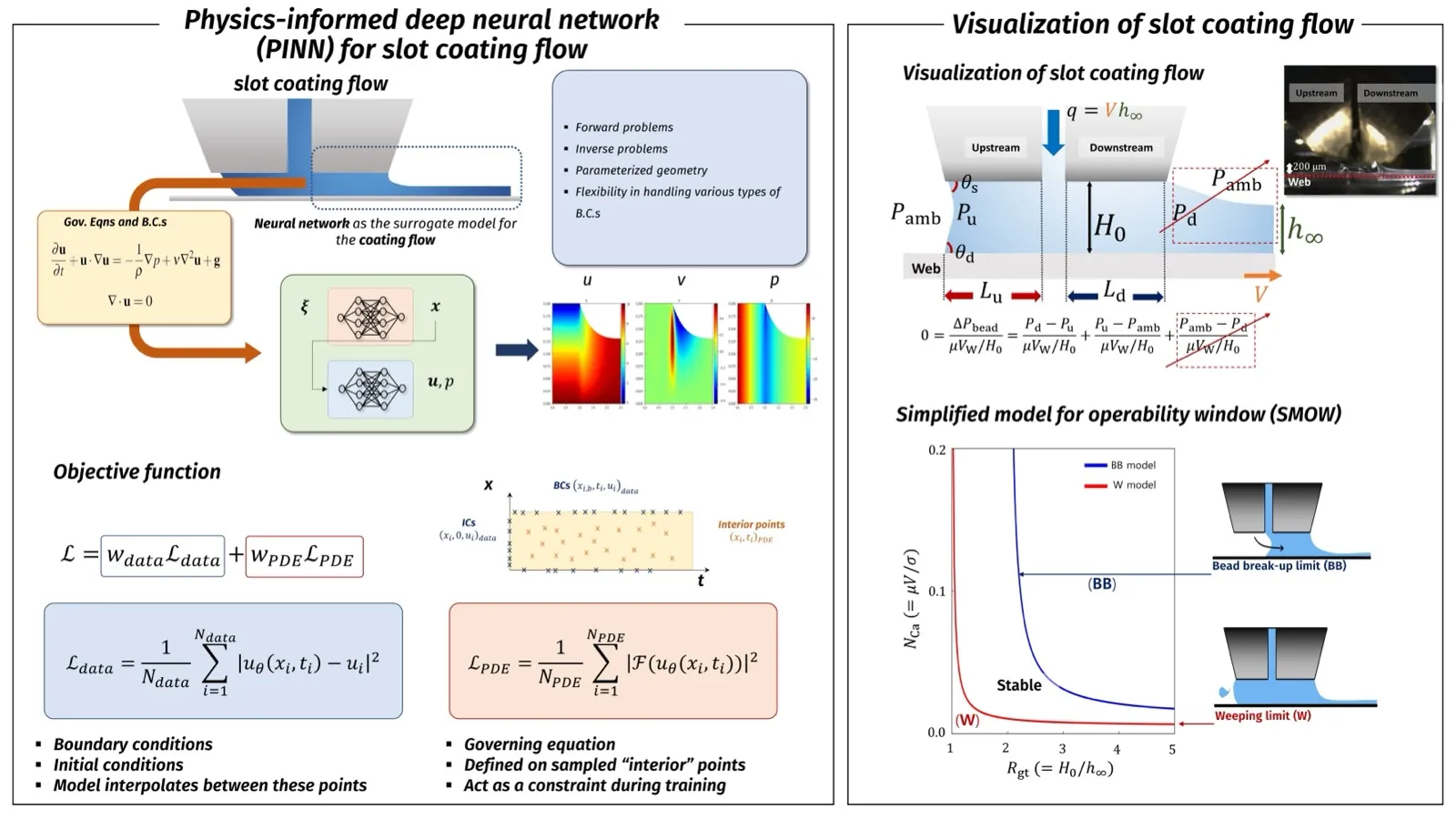
Slot coating decides whether an electrode can be made at all. A liquid bridge — the coating bead — has to stay pinned between the die and a substrate moving at production speed, and the range of conditions where it survives is the operating window. We work on both halves of that problem: predicting where the window is, and changing the die so the window gets wider.
- Operability of slot and patch coating
- Coating windows for continuous, patch, and intermittent coating, where the bead has to start and stop cleanly for the electrode geometries batteries and fuel cells now demand.
- Low-flow and air-entrainment limits mapped against dimensionless groups, so the window carries over between fluids instead of being remeasured each time.
- Die-lip and manifold design
- Inverse design of viscoplastic flow through the coating die, and the effect of shim configuration on manifold flows (see Die Manifold Flows).
- Die-lip shape optimization coupled to the bead-flow computation rather than tuned by hand.
- Computation
- 2-D GFEM free-surface bead flow with elliptic mesh generation, resolving the menisci that set the window boundaries.
- Physics-informed deep neural networks whose loss embeds the finite-element residual, used to accelerate root finding along the window boundary.
- Visualization
- Lab-scale roll-to-roll slot coater with a transparent die for direct observation of the bead, so the computed window is checked against the one the coater actually has.